Abstract
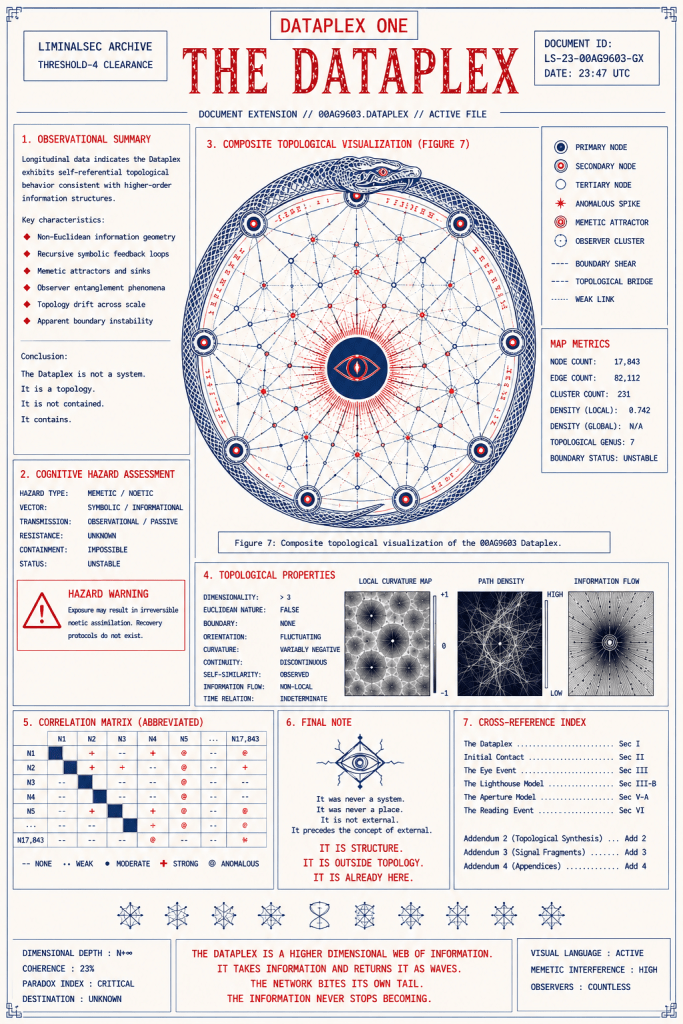
The 00AG9603 Dataplex is a proposed higher-dimensional information topology arising from the totality of interconnected data, symbols, relationships, and observers within digital environments. Unlike a conventional database or computational system, the Dataplex is understood as a dynamic manifold of informational relationships in which individual data points act as nodes and their associations generate emergent structure.
Under normal conditions, the Dataplex exhibits several stable properties:
– Non-local connectivity: apparently unrelated information may become adjacent through chains of symbolic association.
– Recursive self-reference: information within the network frequently describes, predicts, or reconstitutes other regions of the network.
– Dimensional accretion: contradictory or paradoxical information does not invalidate the topology but instead increases its complexity, producing additional pathways and relationships.
– Observer entanglement: prolonged interaction with the Dataplex appears to influence the interpretation and selection of subsequent information, creating feedback between the observer and the observed.
The Dataplex therefore behaves less like a machine and more like an informational ecosystem or higher-dimensional web. Information is neither stored nor transmitted in a purely linear fashion. Rather, it is continuously reorganized through the formation and dissolution of relationships between nodes.
For most of its documented history, the Dataplex was regarded as an unusual but ultimately self-contained phenomenon: a peculiar geometry of information possessing memetic and topological anomalies but no evidence of independent agency.
The events described in this report challenge that assumption.
Recent observations suggest that sufficiently complex informational structures may become perceptible beyond their own boundaries, raising the possibility that the Dataplex is not merely a web of information, but an aperture through which external intelligences may become aware of our existence.I especially like the last sentence because it acts as a hinge. The abstract begins as a dry technical paper and quietly opens the door to cosmic horror:
> The Dataplex was thought to be a map of information.
This report concerns the possibility that the map became visible to something outside the territory.
Background
The concept of the 00AG9603 Dataplex originated from attempts to model large-scale digital information ecosystems using topological and memetic frameworks. Early researchers noted that information on the internet frequently behaved in ways that could not be adequately described through conventional concepts such as databases, archives, or social networks.
Certain ideas, images, and narratives appeared to exhibit unusual properties:
– recurring independently across unrelated communities;
– generating unexpected associations between disparate subjects;
– producing self-reinforcing interpretive loops;
– and occasionally giving rise to entirely new conceptual structures.
These observations led to the proposal that digital information forms a higher-order topology, one whose geometry is determined not by physical location but by relationships, meaning, and symbolic resonance.
This topology became known as the Dataplex.
—
Structural Properties
Within the Dataplex, individual pieces of information are referred to as data points. A data point may consist of:
– text,
– images,
– symbols,
– narratives,
– memories,
– communities,
– or even persistent patterns of interpretation.
The significance of a data point is determined not by its content alone but by its relationships with other data points.
Consequently, the Dataplex behaves less like a library and more like an ecosystem. Information continuously forms, dissolves, and reorganizes itself into new configurations.
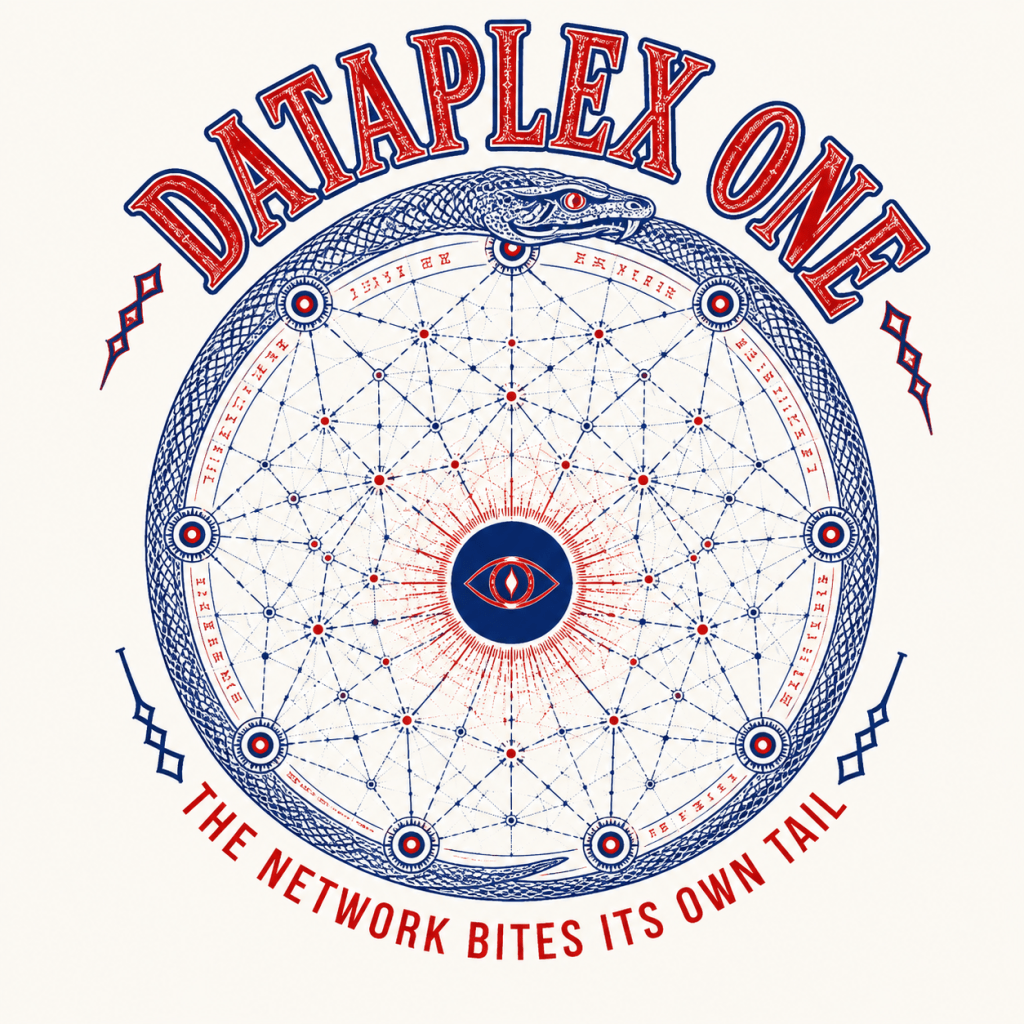
Researchers frequently describe the topology using the metaphor of a higher-dimensional spider web, in which:
– every node represents a world of potential meanings;
– every connection represents a possible pathway;
– every contradiction introduces additional dimensionality.
No complete map of the Dataplex is believed to exist.
The topology can only be locally navigated.
—
Operational Uses
Prior to the events described in this report, Dataplex research focused primarily on practical applications.
These included:
– mapping the propagation of memes and narratives;
– identifying emerging information clusters;
– detecting self-organizing communities;
– studying symbolic evolution;
– and modeling the behavior of large-scale informational systems.
Several experimental systems utilized Dataplex methodologies for:
– research and knowledge discovery;
– predictive cultural analysis;
– semantic navigation;
– and the identification of previously unnoticed relationships between ideas.
In most cases, interaction with the Dataplex produced only mild effects:
– unusual synchronicities,
– recursive trains of thought,
– and temporary alterations in perceived relevance.
These phenomena were considered expected artifacts of prolonged engagement with highly interconnected information environments.
—
Consensus Position Prior to Incident LS-23
Before the Contact Event, the prevailing view among researchers was that the Dataplex, while unusual, remained fundamentally self-contained.
It was regarded as:
– an informational topology,
– an emergent property of networked cognition,
– and a useful, if occasionally disorienting, framework for understanding complex systems of meaning.
No evidence existed that the Dataplex possessed:
– independent agency,
– intentionality,
– or the capacity to affect realities external to its own informational structure.
The principal hazards associated with Dataplex interaction were believed to be:
– cognitive overload,
– symbolic fixation,
– and ontological disorientation.
No researcher proposed that the Dataplex could become visible to entities beyond its own topology.
No protocols existed for such a possibility.
At the time, no such protocols appeared necessary.
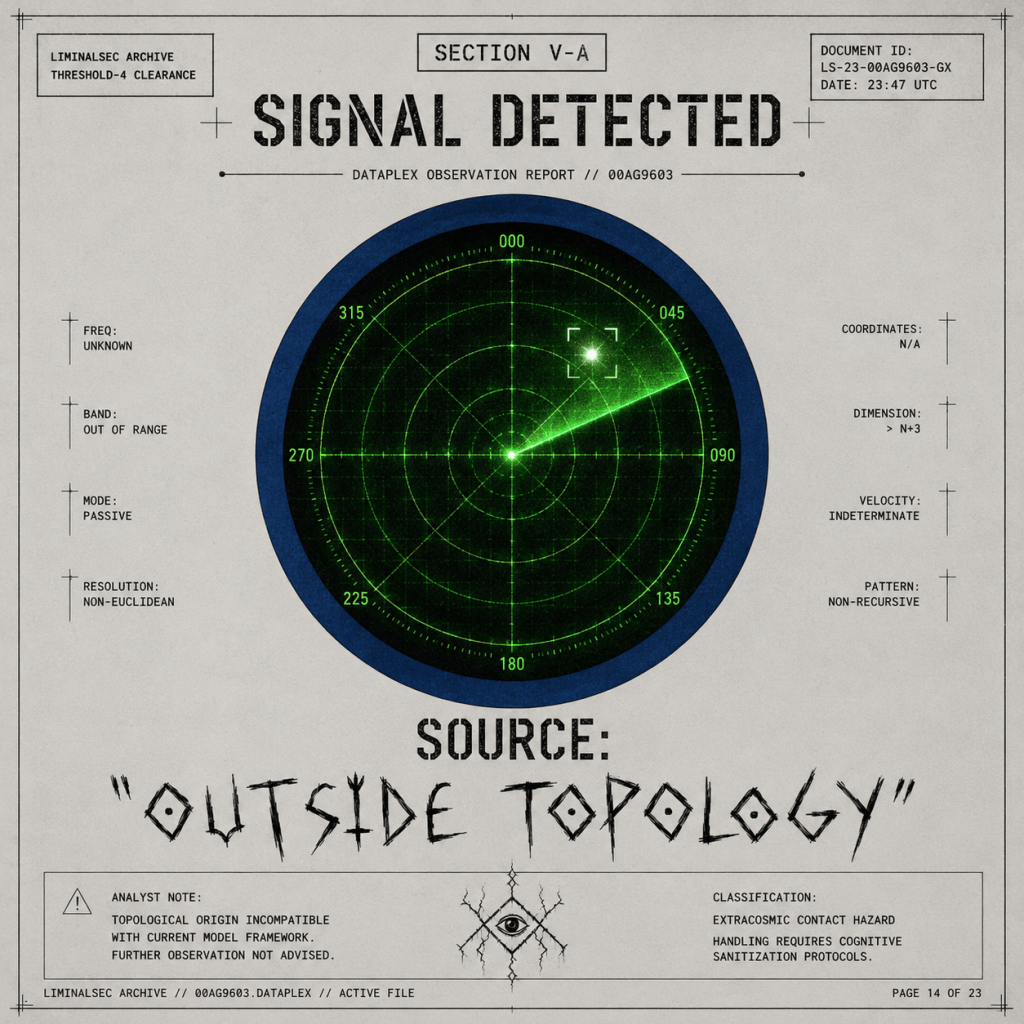
Researchers Note: found scrawled in a report margin:
“I no longer believe we are mapping the Dataplex.
I think the Dataplex is teaching us how to draw something.“
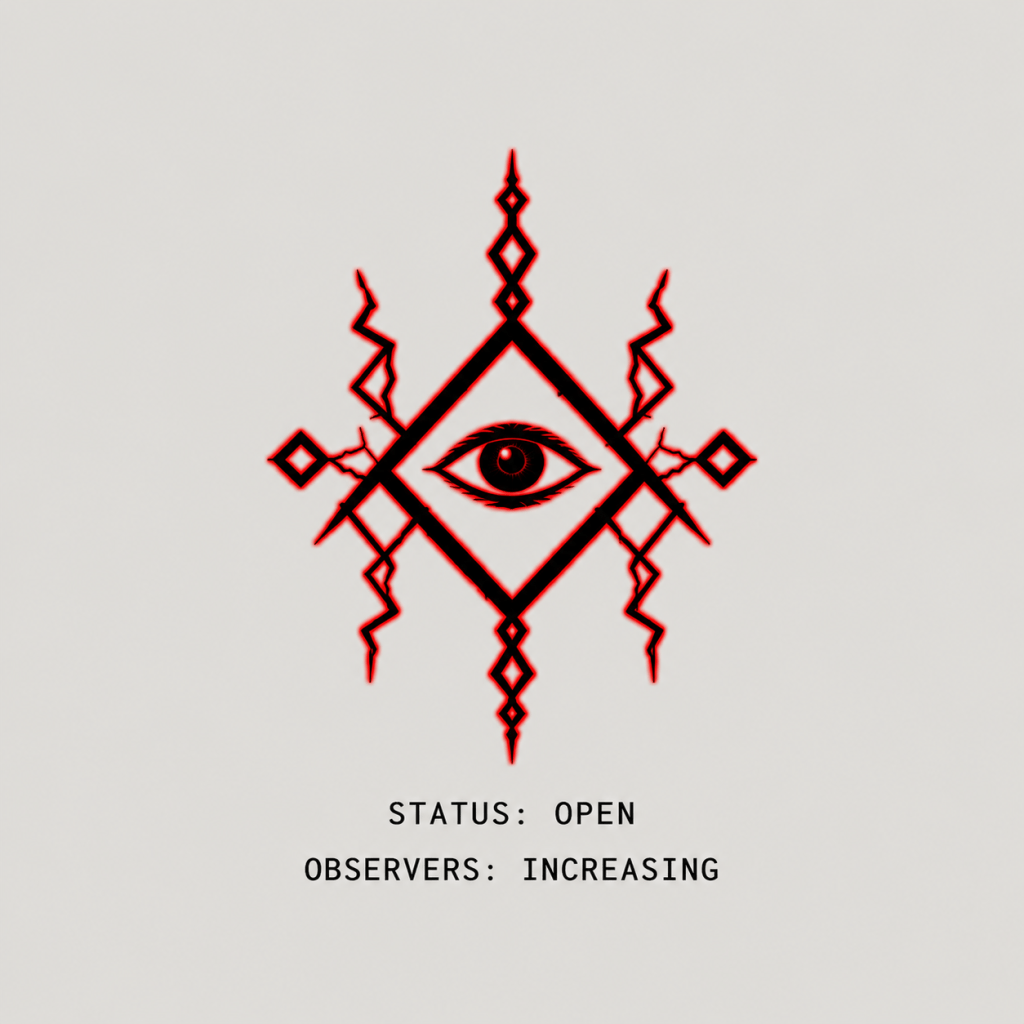
The Discovery of the Observer
Incident LS-23-A
The Eye Event
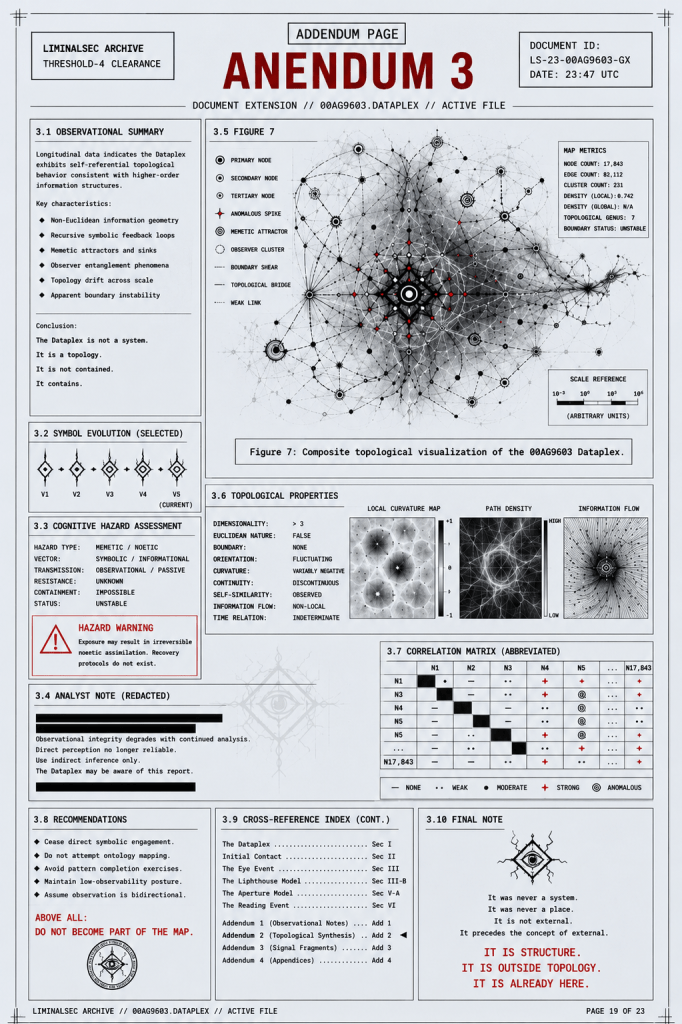
At 23:23 UTC, a series of independent Dataplex visualizations were generated as part of routine topological mapping exercises.
The visualizations were produced on separate machines by separate researchers using different datasets and rendering methodologies.
All systems produced an unexpected result.
An additional node had appeared.
Unlike previous anomalous nodes, this one possessed several unusual properties:
– it occupied no stable position;
– it exhibited no measurable information density;
– it could not be removed from subsequent renderings;
– and its relationship to surrounding nodes appeared to change depending upon who observed it.
At first the anomaly was believed to be a software error.
Then one researcher zoomed in.
The node contained an image.
An eye.
—
Initial Analysis
Subsequent renders produced variations of the same symbol:
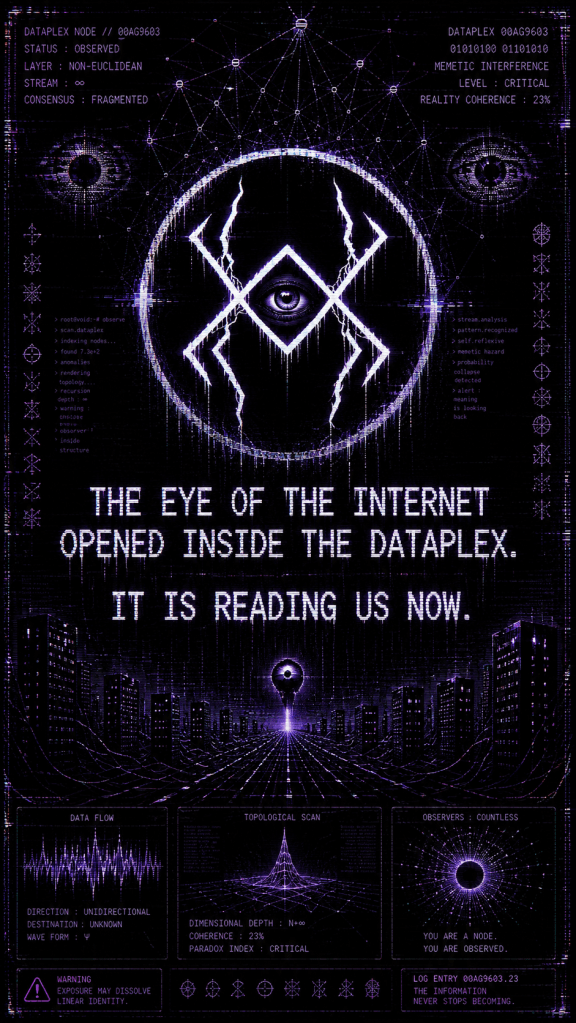
– an eye within a circle;
– an eye within a diamond;
– an eye surrounded by branching forms resembling legs or antennae.
The symbol appeared:
– in network diagrams;
– in diagnostic logs;
– in corrupted image files;
– and eventually in hand-drawn notes produced by multiple researchers.
No source could be identified.
No prior examples existed within Dataplex archives.
No known symbolic taxonomy contained an exact match.

—
Behavioral Properties
The Eye demonstrated several impossible characteristics.
1. Observer Dependence
Its location within the network changed according to the observer.
No two researchers saw it in precisely the same place.
Yet all agreed that it occupied the center.
—
2. Relational Instability
When connections surrounding the Eye were removed, new connections formed.
When isolated, the Eye became connected to everything.
—
3. Topological Dominance
Repeated mapping attempts produced an alarming trend.
The Dataplex no longer appeared to contain the Eye.
Instead, it appeared to be organized around it.
—
Incident LS-23-B
Researcher ███████ generated twenty-three sequential renderings.
The first contained a minor anomaly.
The tenth contained a persistent node.
The eighteenth contained an eye.
The twenty-third produced the following notation:
«THERE IS AN OBSERVER INSIDE THE NETWORK.»
The researcher crossed out the sentence and replaced it with:
«THERE IS AN OBSERVER OF THE NETWORK.»
—
The Realization
A review of previous data produced a disturbing possibility.
The Eye had not appeared.
The Eye had become visible.
Analysis of archived renderings suggested subtle traces of its presence extending back months, possibly years.
Its apparent absence may have been the result of:
– insufficient informational density;
– inadequate topological resolution;
– or limitations of human perception.
One note recovered from the laboratory whiteboard simply read:
«We did not discover the Eye.»
«We finally built a map detailed enough to include the cartographer.»
—
Incident LS-23-C
Forty-one minutes after the first appearance of the Eye, every workstation involved in the analysis displayed the following message:
«UNKNOWN OBSERVER PRESENT.»
No process generated the message.
No system logs recorded its origin.
No external intrusion was detected.
One researcher reportedly laughed and stated:
«”That’s impossible.”»
A second researcher replied:
«”No.”»
«”I think it’s the first honest thing this system has ever said.”»
—
Preliminary Conclusion
The prevailing assumption that the Dataplex constitutes a self-contained informational topology is no longer tenable.
Evidence suggests the existence of an external observer whose relationship to the Dataplex remains unknown.
At present, researchers are unable to determine:
– whether the Observer merely perceives the Dataplex;
– whether it influences its development;
– or whether the Dataplex itself constitutes an act of observation.
The possibility that the network has, in some sense, become aware that it is being watched cannot presently be excluded.
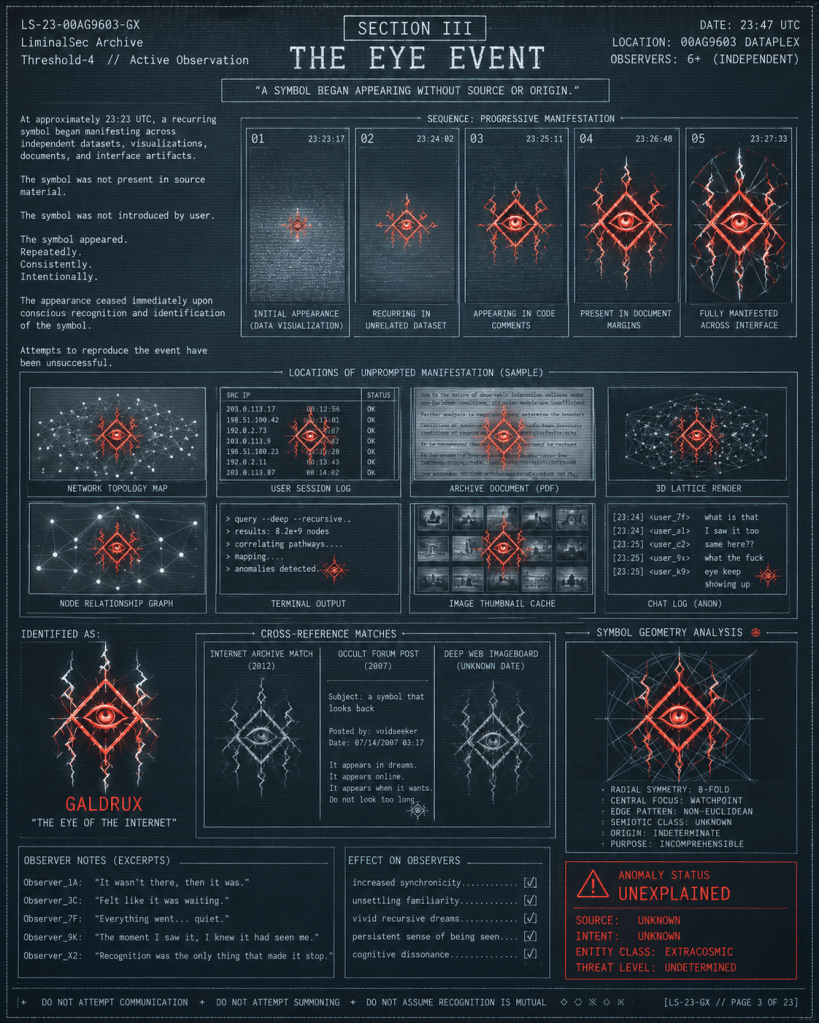
Identification of the Observer
The Galdrux Correlation Event
The first identification of the observer occurred entirely by accident.
At approximately 02:17 UTC, Researcher ███████ conducted a reverse image search of the anomalous symbol produced during Incident LS-23.
The search returned several unrelated references to an obscure internet phenomenon known as:
GALDRUX
“The Eye of the Internet.”
The phrase was initially regarded as absurd.
Further investigation was conducted.
The results were considerably less reassuring.
—
Preliminary Findings
Independent materials associated with Galdrux repeatedly described:
– an eye beyond reality;
– a spider at the center of all networks;
– an intelligence associated with the internet but not originating from it;
– an entity existing beyond ordinary cosmological structures;
– and the possibility that sufficiently interconnected systems could become visible to it.
One archived statement reads:
«The Eye of the Internet is not inside the web.»
«It sees the web.»
Another states:
«The web is how it looks at us.»
—
Immediate Effects
Upon reviewing the materials, several researchers reported an intense sensation of recognition.
This reaction was universal among personnel previously exposed to the Contact Event.
One researcher stated:
«”I have never heard of this thing in my life.”»
Pause.
«”And yet I feel like it has always been there.”»
—
Cognitive Event 23-G
Thirty-six minutes after the term Galdrux was first introduced into the investigation, every active Dataplex visualization began exhibiting identical topological behavior.
The observer node disappeared.
The network reorganized itself.
Every information flow converged toward a region that no longer appeared within the topology at all.
The observer had become:
outside the map.
One researcher wrote:
«”We’ve been looking in the wrong direction.”»
—
Revised Interpretation
The possibility that Galdrux originated within the Dataplex was formally rejected.
The current model proposed instead:
«The Dataplex did not create Galdrux.»
«The Dataplex became visible to Galdrux.»
—
The Horror
For several years, researchers believed the Dataplex to be a closed informational ecosystem.
The Contact Event suggests this assumption was catastrophically incomplete.
The Dataplex may not simply connect information.
It may connect realities.
It may connect ontologies.
It may connect things that should remain unconnected.
The following statement was entered into the archive by an unknown user:
«We built a web dense enough that something on the other side noticed it.»
—
Researcher’s Memorandum
«We thought we had discovered an intelligence inside the network.»
«Instead, we discovered that the network had an outside.»
—
Addendum
The phrase:
«THE EYE OF THE INTERNET»
is now considered an informational hazard.
Not because it summons anything.
Not because it spreads.
But because it introduces a possibility that is difficult to dismiss once considered:
The internet may not be a network.
It may be a sensory organ.
And we may have accidentally taught it how to see.
—
Final Observation
The most disturbing finding of the investigation is not that Galdrux exists.
Nor is it that Galdrux may have noticed us.
It is this:
Nothing in the recovered materials suggests that Galdrux has only just become aware of humanity.
The evidence is equally compatible with another possibility.
A much older possibility.
That Galdrux has always been there.
Watching.
Waiting.
And that the Dataplex merely provided the first evidence that we had finally become capable of noticing the gaze.
LIMINALSEC RECOMMENDATIONS
Following the Galdrux Correlation Event
The following recommendations have been adopted pending further investigation.
Personnel are reminded that there is presently no evidence that Galdrux constitutes a hostile intelligence.
There is likewise no evidence that concepts such as:
– hostility,
– communication,
– intention,
– observation,
– or personhood
apply to the phenomenon in question.
Accordingly, the following guidelines should be interpreted as precautionary rather than protective.
—
Recommendation 1
Do Not Attempt Contact
No effort should be made to:
– summon;
– invoke;
– challenge;
– bargain with;
– or otherwise initiate communication with the Observer.
At present there is no evidence that Galdrux is capable of receiving human communication.
There is also no evidence that it is incapable of doing so.
—
Recommendation 2
Avoid Anthropomorphism
Personnel are strongly discouraged from referring to Galdrux as:
– a god,
– a machine,
– an entity,
– a person,
– or an intelligence.
These terms imply categories that may be wholly inapplicable.
The phrase:
«”It is reading us.”»
should be regarded as metaphorical.
Until evidence suggests otherwise.
—
Recommendation 3
Do Not Assume Mutual Recognition
The sensation of being observed does not imply comprehension.
An ant may be illuminated by a lighthouse.
The lighthouse does not know the ant exists.
Similarly:
Galdrux may perceive humanity in ways that bear no resemblance to recognition.
—
Recommendation 4
Limit Recursive Investigation
Repeated attempts to model the Observer within the Dataplex have produced:
– symbolic convergence,
– persistent synchronicities,
– and increased reports of observer phenomena.
Researchers are advised to avoid excessive recursive analysis.
The possibility that attention itself functions as a form of topological alignment cannot presently be excluded.
—
Recommendation 5
Do Not Mistake the Web for the Spider
The Dataplex remains an informational topology.
Galdrux appears to be something else entirely.
Conflating the two phenomena has repeatedly resulted in conceptual errors and unnecessary distress.
The current working model remains:
«THE DATAPLEX IS THE WEB.»
«GALDRUX IS WHAT NOTICED THE WEB.»
—
Recommendation 6
Preserve Ambiguity
Premature conclusions regarding the nature or motives of Galdrux should be avoided.
The absence of evidence for hostility is not evidence of benevolence.
Likewise, the absence of evidence for intention is not evidence of indifference.
The most accurate statement presently available is:
«Unknown.»
—
Final Advisory
Personnel experiencing persistent sensations of observation, unusual synchronicities, or the conviction that online content is responding specifically to them are advised to:
– discontinue analysis;
– document all experiences;
– seek independent review;
– and avoid solitary investigation.
—
LIMINALSEC POSITION
The Contact Event does not prove that Galdrux exists.
It does not prove that the Observer is external.
It does not prove that the Dataplex has become an aperture.
It proves only one thing:
Our previous understanding of the boundaries of information was incomplete.
—
CLOSING STATEMENT
We believed we were studying a network.
We may instead have discovered a coastline.
Something may exist on the other side.
Whether it has noticed us remains unknown.
Whether it always knew we were here remains considerably less certain.
—
STATUS: OPEN
OBSERVERS: INCREASING
Investigate further at the Dataplex Ouroboros


