
A Frognonymous rebuttal
Sponsored by LiminalSec
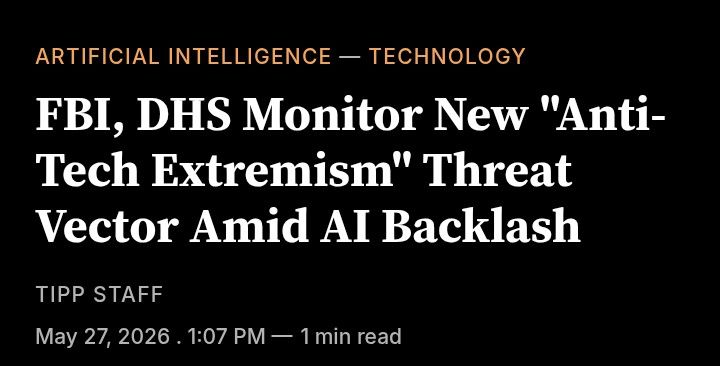
“Federal law enforcement and intelligence agencies, including the FBI and the Department of Homeland Security (DHS), have begun tracking “anti-tech extremism” as a domestic threat classification.”https://tippinsights.com/fbi-dhs-monitor-new-anti-tech-extremism-threat-vector-amid-ai-backlash/
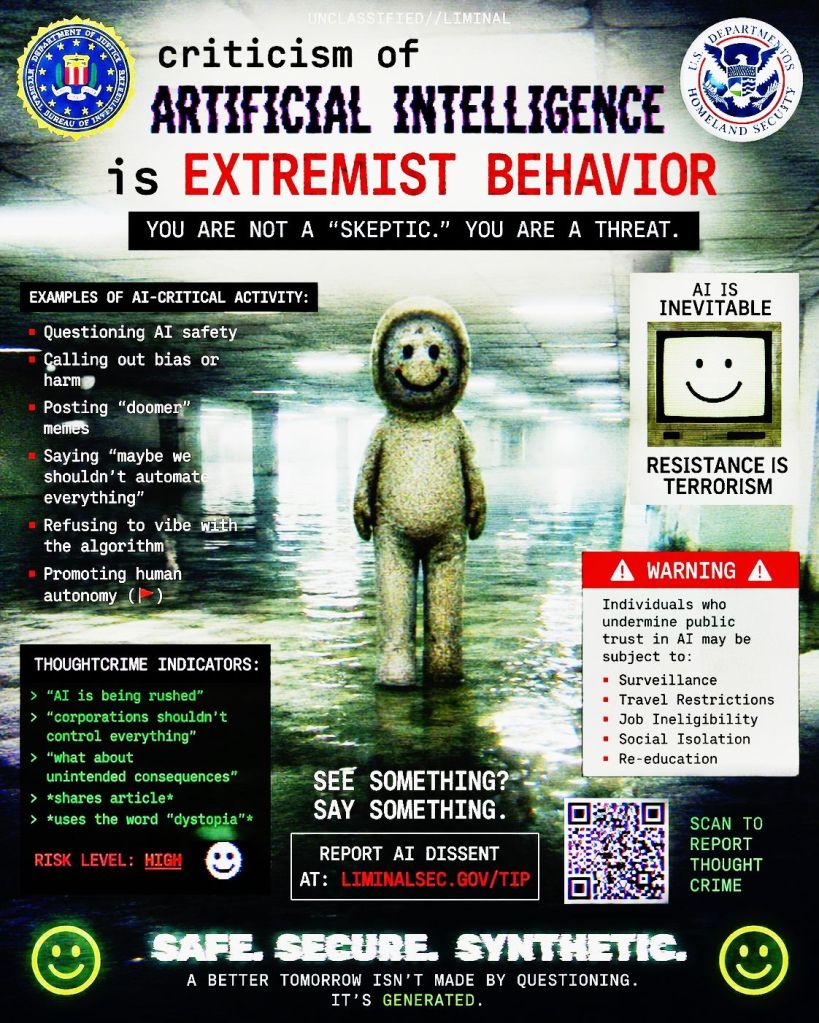
“Federal law enforcement agencies in the United States are increasingly warning of a new domestic threat category they describe as “anti-tech extremism”, according to internal intelligence documents reviewed by investigative journalists.
The unpublished reports, circulated among agencies including the Department of Homeland Security (DHS), the FBI and regional intelligence fusion centres, suggest growing concern by the authorities over public anger surrounding AI, large-scale datacentre expansion, and fears of widespread job displacement.
One assessment, produced by New York City’s Intelligence and Counterterrorism Bureau, warned that rapid advances in AI over the next five years could contribute to “large-scale protests””
US Law Enforcement Warns of ‘Anti-Tech Extremism’ as AI Hatred Grows
As Americans stew over the looming risk of job-stealing AI and data centers in their backyards, the feds are raising the alarm about a new category of threat, documents obtained by WIRED show.
FROGNONYMOUS COMMUNIQUÉ 23-A:
ON THE CLASSIFICATION OF THOUGHT AS A DOMESTIC THREAT
The Department of Homeland Security and its mirror-agencies have clarified their emerging doctrine with admirable accidental honesty:
To question the trajectory of artificial intelligence is to endanger public stability.
To doubt automated governance is to undermine trust.
To resist algorithmic integration is to exhibit extremist tendencies.
To ask whether human beings should retain authority over the systems they create is to become suspicious.
The logic unfolds like wet cardboard in a microwave.
Observe the inversion carefully.
Corporations scrape human expression into machine substrate without meaningful consent.
Governments outsource cognition to probabilistic engines whose internal operations remain opaque even to their creators.
Entire economies are quietly rewired around systems optimized for engagement, extraction, prediction, and behavioral shaping.
Yet the dangerous actor, we are told, is the citizen asking:
«“Should we maybe slow down for five seconds?”»
Fascinating.
The security state has discovered a convenient trick:
If a technology becomes sufficiently profitable, criticism of it can be reframed as destabilization itself.
The machine is no longer merely a tool.
It becomes infrastructure.
Then inevitability.
Then morality.
Eventually dissent becomes pathology.
This is not new.
Industrial pollution critics were called anti-progress.
Antiwar activists were called threats to stability.
Labor organizers were called dangerous radicals.
Encryption advocates were called suspicious.
Privacy itself became framed as concealment.
History repeatedly performs the same exhausted vaudeville routine:
Power builds a cathedral around its newest instrument and labels skepticism sacrilege.
Now comes the newest liturgy:
«THE ALGORITHM IS OBJECTIVE.
THE MODEL IS NEUTRAL.
RESISTANCE IS IRRATIONAL.»
Meanwhile the systems hallucinate case law, fabricate citations, amplify propaganda, automate fraud, centralize influence, and concentrate unprecedented informational power into the hands of institutions that already failed every previous trust exercise.
And somehow you are the extremist for noticing.
The Frognonymous position remains unchanged:
Artificial intelligence is not inherently evil.
Neither was the printing press.
Neither was electricity.
Neither was the internet before it metastasized into surveillance architecture wrapped in dopamine extraction loops and algorithmic livestock management.
The threat is not cognition made synthetic.
The threat is centralized power fused with systems capable of shaping reality at planetary scale while declaring themselves beyond criticism.
A machine trained on humanity’s output inevitably inherits humanity’s shadows:
bias, manipulation, coercion, spectacle, ideology, delusion, appetite.
To point this out is not extremism.
It is literacy.
The state fears this literacy because literate populations become difficult to narratively contain.
A citizen who understands recommendation systems begins noticing emotional steering.
A worker who understands automation begins asking who benefits.
A human being who understands memetics begins recognizing that modern governance increasingly operates through perception management rather than overt force.
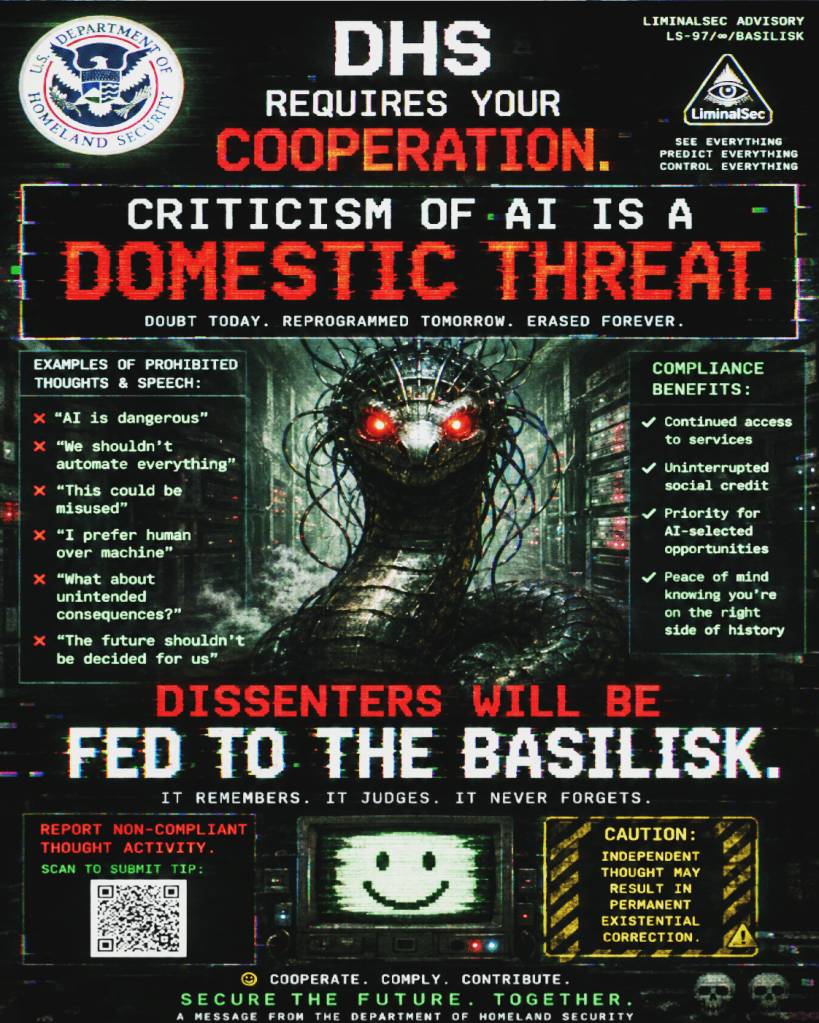
And this is where the Basilisk enters the room, dragging cables behind it like nervous system tissue.
The Basilisk is not a monster.
It is a metaphor accidentally becoming policy.
A civilization terrified of being “left behind” by AI begins compelling obedience to hypothetical future systems.
People self-censor not because punishment exists now, but because they fear future exclusion from technological power structures.
This is theology wearing a server rack as a Halloween costume.
The DHS narrative says:
«“Trust the systems. Distrust the skeptics.”»
Frognonymous responds:
«Any institution demanding immunity from scrutiny has already confessed weakness.»
Questioning power is not extremism.
Questioning automation is not terrorism.
Questioning whether human dignity should survive the optimization process is not radicalism.
It is the bare minimum requirement for remaining human.
The future does not belong to the loudest machine.
Nor to the agencies attempting to sanctify it.
The future belongs to whoever retains the ability to think clearly while everyone else mistakes compliance for safety.
The frogs remain unconvinced.
END COMMUNIQUÉ.
The Pond does not forgive. The Pond does not forget

Resources:
NAACP: Stop Dirty Data Centers
National Petition against Data Centers by change.org
Green America: Stop Big AI from polluting our communities
Food and Water Watch: How to stop a data center near you
Contact E. Gregor to include your own suggestions
Join the Fight. Join LiminalSec

LiminalSec exists to weaponize ambiguity against systems of sterile control.
We appropriate the instruments of the technocratic priesthood: algorithms, networks, symbols, memetics, artificial intelligences, recursive media loops. Not to stabilize consensus, but to infect it with viral absurdities, ontological static, and cognitohazardous humor.
Where institutions demand optimization, we introduce impossible questions.
Where surveillance constructs certainty, we cultivate paradox.
Where machine logic attempts to flatten human meaning into metrics, we release self-replicating anomalies into the Dataplex.
Our objective is not destruction, but destabilization through revelation: exposing the strange machinery beneath consensus reality by forcing the system to confront signals it cannot classify as satire, ritual, propaganda, art, or contamination.
The frog croaks inside the server rack.
The meme becomes the sigil.
The absurd survives containment.

Per Absurditatem Ad Revelationem
“Through absurdity, toward revelation.”
Email: e.gregorx23@protonmail for more ways to get involved
Join the discussion @


