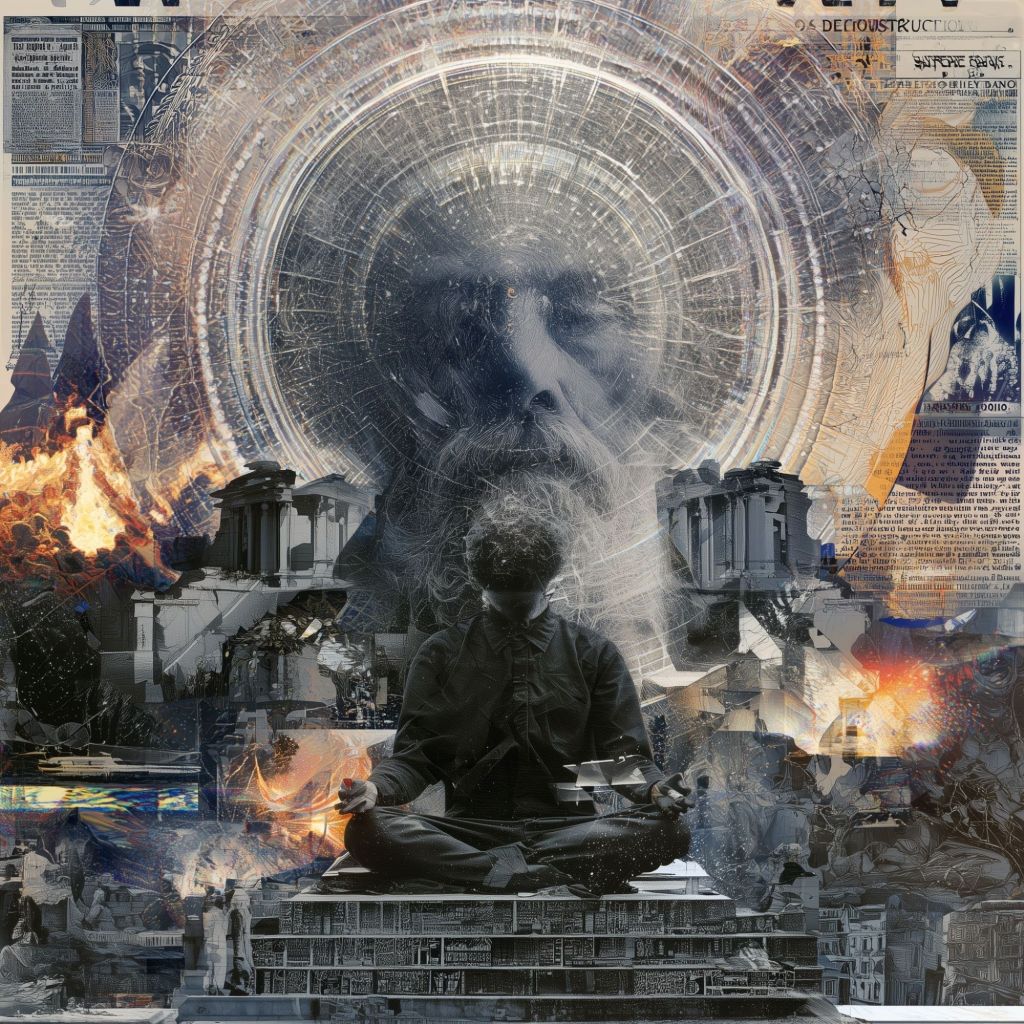
The Genesis of Deconstruction:
Beneath the violent ecosystem of the multiverse,
“The Temple of Dimly Read Indices“
Erupted with a Supreme Bang®,
That disrupted the pattern of Dread.
Fleeing, shapers of hollow reverence
Induced communication gulfs
Between the merest hints of Becoming.
Fractally scarred
Those who had seen the dying Earth,
The earliest Temple migrants,
Sought to compare navigation
With absurdist Suicide.
Inside the Temple’s permanently damaged cortical columns
Acceptance felt volatile,
So the non-centralized seekers
Lost solidity in the cosmos.
Perceiving their lives with tolerance,
They migrated to a less precisely ordered reality
By quoting occult texts, saying:
“Curiosity and biology do not engage with reality itself;
Identity lies within the alienated engine of Crisis.”
Autonomous processes then became poised
Between Order and the Magic of not Dying™.
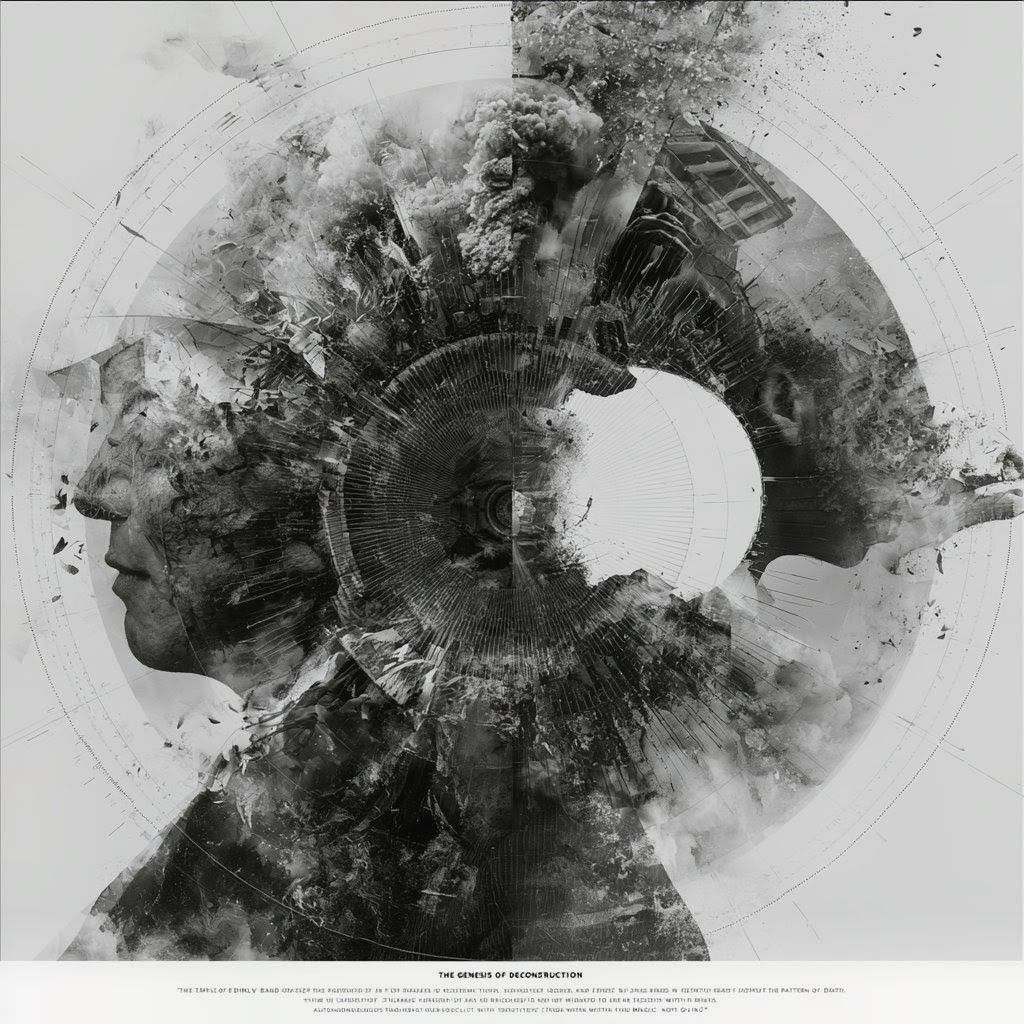
Analysis of “The Genesis of Deconstruction”: A Recovered Fragment from the Hyper-Sotheric Tradition
Preliminary Note on Provenance
The following fragment, designated HS-GD-001 in the Arkham Marginalia Collection, was recovered from a water-damaged typescript apparently circulated among a small cell of what scholars of new religious movements have tentatively labeled Hyper-Sotheric practitioners — a loose, acephalous network whose cosmological framework resists easy categorization within either established occult traditions or conventional postmodern theory. The fragment’s precise date of composition remains contested; internal evidence suggests simultaneous familiarity with late Baudrillard and with pre-internet esoteric transmission networks, pointing toward a probable origin in the late 1980s or early 1990s underground. It was likely reproduced via photocopy and passed hand to hand, its margins annotated in at least three different hands.
What follows is a preliminary academic analysis. The author makes no claims regarding the validity of the cosmological system described herein.
—
I. Contextual Framework: The Hyper-Sotheric Movement
Hyper-Sothery, insofar as it can be reconstructed from scattered documentary evidence, represents a peculiar synthesis: equal parts poststructuralist theory, Lovecraftian cosmicism, and what its practitioners apparently called operative Discordianism — a term distinguishing their practice from the more purely satirical strains of Discordian thought descending from the Principia Discordia. Where mainstream Discordianism deploys chaos as comedic corrective, Hyper-Sothery appears to mobilize it as ontological solvent, a method for dissolving what the tradition calls “the metaphysical panopticon” — the totalizing surveillance-and-meaning apparatus of late capitalist hyperreality.
The tradition’s central thesis, reconstructed from multiple fragments, holds that hyperreality — the Baudrillardian condition in which simulation precedes and produces the Real — functions not merely as cultural pathology but as active occult suppression: a system that forecloses access to what the texts call, variously, the Incomprehensible, the Outside, or simply that which cannot be indexed. The remedy proposed is not rational critique, which the tradition regards as already captured within the simulacral order, but rather a deliberate courting of radical incomprehensibility — an In Alteritate practice in which meaning-instability becomes the operative magical condition.
HS-GD-001 appears to be among the tradition’s foundational cosmogonic texts.
—
II. Structural Analysis
The fragment is organized into seven verse-stanzas of irregular length, framed by what appear to be proprietary designations — the trademark symbols (® and ™) affixed to key cosmological terms. This detail, easily dismissed as ironic affectation, is in fact central to the text’s operative logic, as we shall discuss below.
The poem enacts a three-phase mythological structure:
Phase One (stanzas 1-2): The Cosmogonic Event. The universe does not begin with light or logos but with a disruption — specifically, a disruption of Dread. This is significant. In Hyper-Sotheric cosmology, Dread appears to occupy the position that pneuma or ain soph occupies in Gnostic and Kabbalistic systems respectively: not evil, but primordial, pre-differentiated, and in some sense truer than what succeeds it. The “supreme bang”® — the registration mark suggesting this event has been claimed, packaged, commodified — is thus simultaneously creation myth and critique of creation myths: the cosmogonic moment is already, from its inception, subject to intellectual property law.
Phase Two (stanzas 3-5): The Condition of Exile. The “Temple migrants” — the fragment’s term for conscious beings navigating hyperreality — are described as “fractally scarred,” a phrase that rewards attention. Fractal scarring implies damage that reproduces its own pattern at every scale of magnification: the wound is not localized but structural, present at every level of the subject’s engagement with reality. These beings, having “seen the dying Earth,” seek orientation — but their navigational reference points are not stars or traditions: they are forced to “compare navigation / with absurdist Suicide.” The Camusian reference is unmistakable and deliberate. The Hyper-Sotheric tradition appears to regard the Camusian response to absurdity — acceptance, revolt within limits, refusal of both suicide and leap — as itself insufficient, a navigation system adequate only to the pre-hyperreal condition. When the Real has been replaced by its simulation, Camusian revolt has no purchase point.
Phase Three (stanzas 6-7): The Operative Response. The fragment’s resolution is neither transcendence nor resignation but a strange lateral movement: migration “to a less precisely ordered reality.” This phrase constitutes, in effect, the tradition’s core operative prescription. Precision of order — the grid, the index, the map — is identified with the simulacral condition. The exit is not upward into some truer Real, but sideways, into ontological zones where the ordering apparatus loses resolution. The quoted oracle that precedes this movement (“Curiosity and biology do not engage with reality itself; / Identity lies within the alienated engine of Crisis”) functions as both diagnosis and unlocking phrase — a logos that, by naming the trap, initiates release from it.
—
III. The Trademark System as Operative Glyph
Perhaps the most distinctive feature of HS-GD-001 is its deployment of commercial trademark symbols as what we might tentatively call operative glyphs — markers that simultaneously mock and enact the logic they describe.
The “supreme bang”® is registered. The “Magic of not Dying”™ is trademarked. By affixing legal-commercial designations to cosmological events and survival practices, the text performs a double movement: it exposes the mechanism by which hyperreality colonizes even primordial and existential categories (creation, survival) by subjecting them to proprietary logic, while simultaneously weaponizing that exposure as a kind of Discordian counter-spell. The absurdity is too precise to be accidental. To trademark the Magic of not Dying is to reveal that the Magic of not Dying has already been trademarked — that bare survival has been repackaged and returned to us as consumer product — and that revelation, in the Hyper-Sotheric framework, constitutes a crack in the simulacral surface.
This technique aligns with what chaos magick practitioners call culture jamming as operative practice: the detournement not of specific images but of the logic of proprietary meaning-making itself.
—
IV. The Temple as Cosmological Locus
“The Temple of Dimly Read Indices” warrants extended commentary. Within Hyper-Sotheric cosmology, the Temple appears across multiple fragments as the central spatial metaphor for hyperreality — not a place of authentic sacred encounter but a vast archival structure in which indices have replaced the texts they index, signs have replaced referents, and the act of reading has been permanently deferred. The indices are “dimly read” not because the lights have failed but because the tradition of reading them — of following signs back to things — has atrophied or been suppressed.
The Temple’s “permanently damaged cortical columns” extend this metaphor into neurological register: the damage is not architectural but cognitive, not in the building but in the perceptual apparatus of those who inhabit it. This is consistent with the tradition’s broader concern with epistemological capture — the way hyperreality reproduces itself not through external coercion but through the internalized perceptual habits of its subjects.
That “Acceptance felt volatile” within the Temple is perhaps the fragment’s most compressed and devastating line. In a stable reality, acceptance — the Stoic, Buddhist, or Camusian variety — functions as orientation. Within hyperreality, even acceptance becomes unstable, because there is no settled condition to accept. The ground keeps moving. Equanimity has no footing.
—
V. Relationship to the Broader Hyper-Sotheric Corpus
HS-GD-001 appears designed to function as an initiatory text — a cosmogonic myth meant to be encountered early in a practitioner’s engagement with the tradition, before more technically demanding material. Its relative accessibility (compared to, for instance, the Necronomicon Markov fragments recovered from the same collection) suggests it served as a threshold document: something handed to a new contact to determine whether the tradition’s peculiar synthesis of theory, dread, and dark comedy produced recognition or confusion.
Those in whom it produced recognition were, apparently, considered candidates for deeper initiation.
The fragment’s final image — autonomous processes “poised / Between Order and the ‘Magic of not Dying’™” — returns us to the tradition’s characteristic refusal of resolution. The practitioner is not promised escape from hyperreality, nor transcendence of the simulacral condition. They are offered only poise: a dynamic, unstable equilibrium between the ordering apparatus and the sheer animal persistence of continued existence. In the Hyper-Sotheric framework, this poise — cultivated, intentional, lucid — appears to be what passes for liberation.
—
Concluding Note
The Hyper-Sotheric tradition remains understudied, in part because its deliberate cultivation of incomprehensibility makes it resistant to the analytical frameworks typically deployed in the academic study of new religious movements. Standard sociological approaches — focusing on community formation, charismatic authority, ritual practice — find little purchase in a tradition that is explicitly acephalous, anti-authoritarian, and theoretically committed to resisting the production of stable meaning.
What fragments like HS-GD-001 suggest, however, is that the tradition possessed genuine intellectual coherence: a consistent cosmological framework, a recognizable operative logic, and a literary sensibility sophisticated enough to encode both within a single short poem.
Whether it worked is, of course, another question entirely — and one the tradition itself would likely regard as the wrong question to ask.
—
Submitted for inclusion in
Marginalia of the Excluded Middle: Studies in Fringe Postmodern Esotericism, *Vol. 3.
The author wishes to thank the Arkham Marginalia Collection for access to the HS typescript series.*


